Thursday, 21 December 2017

T'was the week before Christmas: Science Immersion

This blog is written by a grade 1/2 teacher who continuously looks at ways to open up new opportunities for her children to learn.  She loves to pique their curiosity.  This year, she is pairing up with a secondary teacher for a number of different adventures.  Here is one.

We hope you enjoy this Christmas Science Blog… and that you have a wonderful holiday.


T'was the week before Christmas
and all through the school,
The teachers and students were forgetting the rules. 
The kids were quite hyper and completely strung out,
In classrooms and hallways they were shouting it out.
And so … What better time to have an excursion?
Let’s walk to Pen High and have science immersion!

The children got nestled all snug in their jackets,
With visions of science experiment rackets.
And me in my mittens, my toque, and my boots
Met up with Mrs. Dietrich … as we’re in cahoots!

Now what should greet us when we came up the stairs?
But five different stations, and smoke in the air!
Station one had some borax and even some glue,
The children were wondering what they should do!

Next were the candles that somehow should float,
And lighting up matches for our new candle boats!
And some of the kids had fun with the milk,
When dish soap made colors psych-edel-ic!

Burners were risky, but with big kids great help,
Our hair and our eyebrows never quite smelt!
Ion sticks made flames some holiday colours
While small smiling faces turned to show others.

Hydrogen popper were scary and fun, 
The kids watched the bubbles and used fire when done.
The pop was so loud. . . it made many squeal.
To see science work was really surreal.

And when we were finished; our thankyous all said,
We walked back to school; kids ready for bed.
And after this trip was all said and done…
We knew science was cool . . . and learning was fun!


Merry Christmas to our big buddies.

Blog post by Nicola Korvin


Monday, 11 December 2017

Cross-Grade Connections Through Outdoor Learning Experiences

November 2 marked the first day of snow this season.  It also marked an outdoor adventure day for a group of grade 10s from PenHigh and the grade 1/2s from Queen’s Park Elementary.  The two groups were brought together to share in a special field experience at Skaha Bluffs Provincial Park.  Despite the chilly temperatures and unfamiliar surroundings the kids were fast friends as they stepped into the wilderness together. 

 Prior to the trip the grade 10s had recently completed a Wildlife Monitoring project based in the park.  The project focused on wildlife specific to the Bluffs and culminated with student-led data collection using motion-sensor cameras.  The scaffolding lessons leading up to the project were designed to connect the students to our community and the local landscape.  Some of the activities included meeting with a conservation biologist, researching local wildlife-conflicts and learning how the Penticton Indian Band is helping to restore the bighorn sheep population.  Needless to say the grade 10s had a lot of experience and knowledge to share, even though they might not have realized it.

For the grade 2s this outdoor experience would be the first of a series of field trips aimed at connecting students to the local environment.  The classroom content (adaptations, cycles and communities) they had been working on translated to a strong foundation of understanding and good preparation for our outdoor adventure.

The morning together was full of partnered activities that engaged the senses and promoted exploratory play.  From a teacher perspective the most powerful piece of this partnership was the leadership opportunity it provided to the grade 10s.  Not only did they orchestrate the set up the motion-sensor cameras (which is more complex and strategic than one might think) but they also got to role model behaviour that respected and honoured the wildlife within the park.  The enthusiastic and energetic grade 2s were the perfect audience (and partners) for the older students.  Their natural curiosity, wonder and desire to explore was infectious and energizing for the grade 10s.  More importantly, the grade 2s were unencumbered by cell phones which left them free to enjoy the experience, a shocking and novel concept to the grade 10s. 

The unintentional role modelling demonstrated by both groups during this outdoor experience was powerful and only a small part of the transformative work that can happen when we let the land be our teacher.  Thank you to HCTF Go Grants, the Vancouver Foundation who supports this work, and all of the students who allow experiential outdoor programming to happen.

Blog post thanks to Allison Dietrich and her work with Nicola Korvin 

Tuesday, 5 December 2017

Authentic Tasks - Busking and More


Recently, students from two of our secondary schools came together with other community musicians to hold an amazing concert.  This concert was a fundraiser to support the completion of a building project in an orphanage in Tanzania.  It is an orphanage that over 150 students from SD67 have worked and played in over the past years on an annual trip.  

Solos, small groups, and a community choir all played a part in the evening, as well as a 75 wind ensemble. It was a real concert, with the community invited to come and enjoy.  Concerts like these, especially when they are for a purpose and are performed with other community members are important.  

There’s a trend in some educational circles to ensure that students engage in a performance piece to share their learning. With youtube, twitter and easy to create webpages, students can share their learning with a global audience. 

Teachers often say that we are preparing students for the real world. Dr. Grant at Princess Margaret believes in this statement. While teachers can assign grades to a student, or friends can laud a student’s achievement, Dr. Grant wanted to let the world give them feedback.  The concerts that he involves the students in are not the only way he does this.

On a sunny afternoon last spring, band students from Princess Margaret Secondary ceased to be students. They became musicians. Dr. Grant had students bring their instruments to the bustling center of Nanaimo Square in Penticton to play music as buskers. At this point, no grades or teacher input mattered. Students would find out how a real world audience would appreciate their music – and pay up in the form of tips. Students set up in several locations around a two block radius. Business people, shoppers and locals walked by. Many stopped to admire the music being played by the students, bringing joy to a perhaps otherwise busy and stressful day. At one point, a man who had been collecting bottles walked up to two students and deposited some change in their guitar case after flashing them a grin.

Students were nervous. They had to set up in an unfamiliar – non school setting – and place themselves at the mercy of an eclectic audience. They had to seamlessly read the crowd. Was it a younger audience who might like pop music? Were they baby boomers craving classic rock? Were they elderly listeners who might appreciate some Elvis?

Students had to exercise skills such as judicious song choice, choice of location (was it at a busy thoroughfare, was it too sunny to read the music? Was it too close to a fountain which would drown out their singing?) and consider other factors.

School and concerts in gymnasiums are incredibly controlled affairs. As his students busked in the streets, adding to the flair of downtown Penticton, Dr. Grant looked on, commenting how this type of experience is the type that is just uncomfortable enough to help his students grow, gain self-confidence and develop many skills. 

Post Courtesy of Dr. Don Grant and Jeff Fitton

Sunday, 29 October 2017

Localizing Indigenous Perspectives in Science

Last May, educators braved the weather for a professional development session held entirely outdoors. Our focus was to explore the respectful and appropriate representation of Indigenous perspectives within the K-12 science curriculum. Our guiding document was the new FNESC Science First Peoples Teachers Resource guide. While the guide is targeted at grades 5-9, the guidelines for balancing Indigenous and Western knowledge systems are helpful for any grade. In fact the introductory chapters of any of the FNESC educational resource materials are highly recommended for K-12 educators in any subject area who are striving to increase Indigenous perspectives in their own contexts.

Here are a few things we considered to make the session as meaningful as possible:

SD67 Cultural Coordinator Anona Kampe sings the Okanagan Song
1. The importance of connecting with local community members. As most of the session's participants were not Indigenous, we felt it was important to model the intentional inclusion of people from the Okanagan Territory who were willing to guide and support us in our journey forward. SD67 cultural coordinator Anona Kampe began our session by singing the Okanagan Song and providing background on the connections between the Syilx people and the land. Another member of the Okanagan Nation, Carrie Terbasket attended the session as an observer and provided us with valuable feedback regarding what we were doing well and how we could improve. Finally, the last 45 minutes of our session were spent with Dustin Louis, another member of the Okanagan Nation who shared the foundational captikwÅ‚ story How Food Was Given. Dustin infused the story with NsyilxcÉ™n words and phrases and provided background on the importance of Indigenous language, as well as the importance of a sense of place.

2. The importance of localizing the activities. While the activities we shared were inspired by the FNESC resource guide, each one was revised to make it relevant to students' lives in the Okanagan. Station one which was based on Chapter 3 in the FNESC guide "Power from the Land" involved the study of paddling a canoe as an opportunity to explore the concepts of force and motion. As Penticton is located between two beautiful lakes, this unit is particularly relevant. Participants watched a live demonstration of a canoe and a paddle board and then watched part of a video clip that gave a local perspective on the cultural significance of canoeing. In addition to the "Power from the Land" activity, a second station was developed that reflected the reality for everyone who lives in the Okanagan which is the possibility of extreme forest fires. At this station, participants tested and compared soil samples from before and after a fire, and examined photos that compared local methods of Syilx fire management practices with municipal government strategies. The third and final station involved a STEM challenge that involved reducing pollution in connection with efforts by the Okanagan Nation to reintroduce sockeye salmon into local waterways.
Comparing Syilx resource management with municipal strategies
Preparing for the STEM challenge
3. The importance of concepts described in the FNESC Science First Peoples guide that are necessary for understanding Indigenous knowledge including: interconnectedness, a sense of place, the inclusion of Indigenous languages, the use of place names, the importance of story, and the awareness of Traditional Ecological Knowledge (TEK).  We also tried to model the First Peoples Principles of Learning by making sure the session was experiential, collaborative, personalized, connected to the community and the outdoors and respectful of the land. It was an excellent reminder that if we want students to have learning experiences that reflect these elements, then professional development opportunities for educators should mirror the experiences we hope to create for students.

Saturday, 7 October 2017

It's More than just BURLAP

SD67 and SD53 have begun a joint project called Making Learning Visible.  It is under the TADL umbrella because it is all about viewing the child as a competent citizen full of strengths they can offer the community, and full of curiosity about the world.

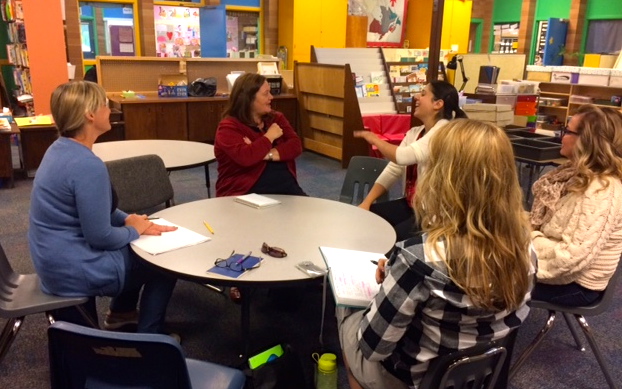
A group of us spent two days with Dr. Laurie Kocher from Capilano University.  She spent time in teachers' classrooms asking questions, and helping each teacher ponder their own questions.  She also gave an after school session for anyone interested in learning about the principles of  teaching using a Reggio Emilia approach.

Here are some of the things that have stayed with me: some complex big ideas and some things that clearly overlap with the work we have been doing in Through a Different Lens for the past 8 years.  

The Image of the Child

In Reggio Emilia, children are seen as protagonists, collaborators, communicators, citizens, and researchers with 'endless potential'. Teachers are viewed as partners, nurturers, guides and researchers, and parents are genuinely seen as partners, because they contribute and are involved in meaningful and complex ways.

Any district work or decisions made by teachers and administrators reflects how we view the child and what we value.  Loris Malaguzzi, the founder of the schools in Reggio-Emilia, in an article "Your image of the child:  Where teaching Begins" says that you teach based on your image of the child:

"There are hundreds of different images of the child.  Each one of you has inside yourself an image of the child that directs you as you begin to relate to a child.  This theory within you pushes you to behave in certain ways; it orients you as you talk to the child, listen to the child, observe the child.  It is very difficult for you to act contrary to this internal image."

Language We Use To Describe Children

In the city of Reggio Emilia, children that we often describe as children with special needs are described as "children with special rights".  These children are the first to receive a spot in municipally funded schools along with those children who do not have extended family support in the community.  Why? Because this reflects their values of supporting and nurturing children and building community.

The language of "children with special rights" reflects their  image of the child as curious and full of strengths rather than the North American view of deficits and "fixing".

Ways That Children Communicate

"The 100 Languages" is the idea that children communicate and represent their ideas in a vast variety of ways such as talking, dancing, drawing, and sculpting.  Children learn in 100 different ways and can express their thinking in those 100 ways.  This reflects the child's "endless potential".

This writing by the founder of Reggio Emilia describes the 100 languages.  We have certainly seen the results of thinking in this way in Through a Different Lens over the years as we have witnessed students come alive when their strengths are recognised and valued in the classroom and in learning.  We have seen them become stronger, more confident, and more appreciated and respected by others as they show their strengths though using art, digital media, photography or music to represent their understanding.


The Environment

In Reggio Emilia the environment is seen as "the third teacher"; it is an environment that reflects the values that we want to communicate to our children and a space that is responsive to learning together.  It is an environment that fosters creativity and relationships with parents, teachers, the learning materials and each other.   In these classrooms, materials are there to provoke investigation or curiosity and also to be used to help the child express their thinking.

Laurie Kocher talked about Pinterest as communicating a view of what Reggio classrooms look like, but that is actually not true of Italian classrooms.  The idea of the environment is to create an authentic learning  space that reflects your values, one where both the teacher and children want to be to create and learn, and where children have a voice in their surroundings, and their learning is documented.  It is more than just burlap on the wall.  It is a co-created space for curiosity and learning.

It was a full 2-days of deep wonderings by the teachers, with reflections on our values, our practice, and our image of the child.    We will continue to work with Dr. Laurie Kocher throughout the 2017/18 school year.

Contributed by Judith King, SD67