Wednesday, 27 February 2013

The Edible Fraction/Percent/Decimal


Often fractions to decimals to percents can be one of those topics that students who struggle with poor number sense find challenging.  Because of this, I often resort to teacher-led instruction on this unit.  I was finding that my traditional mode of delivery for this unit is mainly lecture, board examples, and worksheets.  As much as you can try to make the worksheet questions entertaining and fun, I thought that I would tackle this concept by a hands-on activity this year.  Their mission: to visually show using any objects they wanted, a fraction, and then show how they convert to a decimal and a percent.  They then had to take a photo of it and submit the photo as the mark.  The idea came from the "Twizzlers" math picture book where they show licorice in fractions, the conversion to decimals, and then percents.

This project let me to some very interesting observations.  My stronger students in class were very creative in their representation of the fractions/decimals/percents, but some of them ran into issues as they were trying to get too fancy.  Some of the students that I would say had a weaker number sense took on a great leadership role in this activity.  Their pictures were clear and concise, and often were easier to follow.

Another bit of a risk that I took with this activity, is that in other photo-based activities in either Math or Science I have been using the school cameras.  This time I allowed the students to bring in their own camera and they needed to email them to me once they were done.  The excitment was huge that they were allowed to use their own devices.  And the maturity around using the devices was also impressive.  The students were working in groups of 4 for this activity.  Again, I was very pleased to see that in many of the groups, the leader of the group was not who I would have anticipated.  Leadership and confidence came out of the woodwork on this one.  And lots and lots of having fun!  Since we were using the larger white boards as the background, the students could still show their work and their thinking behind their conversions, which is important.  And with each group very much engaged, it was easy for me to get around to each group and make sure that their thinking was correct and on the right track.  It was a fun couple of days and I was impressed with the learning and practice of the topic.

Post courtesy of Shona Becker

Monday, 25 February 2013

Wasteland (Comparative Civilizations 12)


"Wasteland", a film by Lucy Walker about the artistic endeavours of Vik Muniz, tells the story of "recyclable object pickers', or 'catadores' who make their lives and living in the landfill of Rio de Janeiro.  He changes the lives of these people by photographing them and then, as a group, creating artistic renditions of those photographs using recyclable material from the landfill.  Those renditions are then turned back into photographs, and then auctioned in London, where one fetches a sum of $50 000.  The money is then given back to the project's catadores who use it for various purposes, such as the creation of an adult school.

As a class, we take two periods to watch the documentary and then discuss the term 'hero' and what it means, who embodies the principles of heroism, and who are our current or past heroes/heroines.

From there, students are to select (as a group) one person (dead or alive) who is a hero/heroine to them.  Then, they are to gather recyclable objects for Friday's class in order to create a portrait of their chosen hero/heroine.  They are given the one class to place the objects on a student sized whiteboard in order for the photograph to be taken.  We aren't auctioning them, but if anyone wants to buy a photo, we'll consider all offers over $1000. ;)

Post courtesy of Lesley Lacroix

Wednesday, 20 February 2013

Science Songs (Grade 4/5)


You know how a song can get stuck in your head sometimes and then you find yourself singing or humming some annoying snippet of it well... PERFECT!  We want information to "stick" in our students' minds better so we have been making more use of songs in science.

Last year we used head, shoulders, knees, and toes for a song parody for part of a unit on government.  This time we found some examples of song parodies to show the students first so they understood what a parody was.  Then we brainstormed well known nursery rhymes type songs (is that what they are?) and Christmas carols.  The students were carefully grouped together and given limited time to create a song that covered the key learnings of the muscles, skin, bones mini unit in science.  They could pick any song to parody.  The results were surprising, and by adding more choice to the activity students were more creative and came up with some great stuff in the very limited time we had (we were in a bit of a rush).

Music and song- another powerful learning tool!

Post courtesy of Kent Percevault

Thursday, 14 February 2013

Dear Penpal


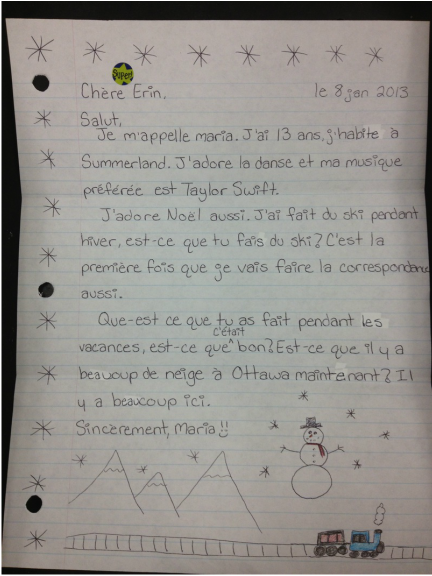
When you write an email or a text to a friend, do you care about your sentence structure? grammar? spelling? And what about when you write an old fashioned letter (and actually go to the post office or put it in the letter drop)? Do you care about your spelling and grammar then? These are the questions I pondered whilst I was marking my immersion students' penpal letters last weekend. They are corresponding with students in Ottawa in French and so both parties are writing in their (likely) second language. Most of my students seem quite engaged in this project.  Who wouldn't want to "pass notes" with someone on the other side of the country and get points for it? Or so I thought...
Here's what I have learned so far by reading their penpal letters:

1) In terms of quality of writing, it was a "mixed (mail?) bag".  Some letters were very well written; the author had taken care with his or her work- so as to not make a mistake and have their penpal see it- that would be embarrassing! Other letters were not so carefully written and met the bare minimum requirements- hmm either the student didn't like the writing process or hasn't decided yet if they really care about having a penpal? Others were somewhere in the middle. They had good questions for their penpal, but perhaps lacked good sentence structure, spelling or grammar.
2) I learned stuff about my students! It's interesting what they will share with someone their age (albeit someone they have never met and in a different province) that they don't share in class. I discovered a lot about their families, hobbies and interests by reading what they wrote about themselves.
3) I thought students would take more care in the editing process of writing their letters since someone (other than me) would actually be reading them. I'm not yet convinced that this is totally true.  After all, do kids that instant message each other via FB, Twitter or text message (and who have never met) care about spelling and grammar? And is it different when you text or email someone vs. when you hand write a letter?
4) Finally, does it even matter if their grammar, spelling and punctuation is correct in this authentic cultural activity? Is the benefit of the task simply in doing the task itself?

    Questions aside, I'm very much looking forward to continuing our correspondence with our penpals in the nation's capital. Perhaps exploring the writing process further with my students will just be an added bonus.

P.S. Perhaps one of them has met Stephen Harper? ;)

P.P.S. Here are two examples of student letters:

Post courtesy of Melissa Hunter

Monday, 11 February 2013

Sharing Creative Resources

French teachers Lindsay Anderson and Marcus Krieger have both recently tried a new resource (Rage Comics) in their classrooms. Lindsay's student accessed an app on his phone, and Marcus used the web-based program as an option for his entire class (after learning about it during a sharing session with Lindsay) Their respective posts are below:

Lindsay: I have always seen these little comics on my cell phone (funny picture app called "Rage Comics").  This student handed an assignment in by using a program that uses the funny picture app template!  He had fun making it, and everyone wanted to see it because they recognized the pictures.
The original assignment was to draw, use the computer, or act out a skit for the vocab. He came up with the idea on his own.


Marcus: My French 9 classes were in the library and computer lab last week creating a story. Students had the option of creating a comic strip (by hand or by using Comic Life or ragemake.net - which creates a comic with "rage" characters), a children's book, a storyboard, a poster, or a Power Point among other options.  The purpose of the project was to use their knowledge of French verb conjugations and vocab to write a story that flowed and (sort-of) made sense. We had brainstormed ideas and everyone had some (or all) sentences written out before heading to the library.


The majority of students chose to either draw cartoons/storyboards or use ragemaker to create comic strips. One student used ragemaker to make a children's book. 

Here is one student's comic strip as an example of what can be done using ragemaker. 


Wednesday, 30 January 2013

Fed-Ex Day


The other day I booked the library and adjoining computer lab for the classes I teach.  I borrowed the idea from a TED talks video I watched - Daniel Pink: The Puzzle of Motivation.  His talk is quite interesting in that it identifies the skill set workers (our students) will need for the future and tied it into a couple of progressive companies who offer their workers time... time to focus on anything they want with the catch being they have to deliver something the next day.  He referenced Google - who offer 20% of their workers time - and from that time google docs, google news and chrome were created.

Students could investigate any topic they wanted but had to present to either the whole class, small groups, or an adult.  I was curious to see how 14/15 year-olds would spend their time.  It was fascinating to see those who were extremely engaged basically disappear into the rabbit hole as they researched a passion or curiosity of theirs.  It was just as fascinating watching others flounder with the freedom and time.  Without direction from me they struggled.

Here are a list of topics they explored (they are as diverse as the students in each class) - card tricks, sleep efficiency, why Africa is poor, planning a surf trip to south Africa, Matisse, origami, Esperanto Language, unicycles, 3D animation, car engines, Anna Pavlova, ski resort trips, corruption in politics, buying an island, black holes, cities in England to visit...

Observations:

1.  As expected students learned in very different ways (they were not told how to learn or how to record their evidence).  Most mixed the visual (video) with the written.  It reaffirms the need to provide both the visual and text during instruction.  The inclusion of video is vital to today's learner.

2.  I surveyed students afterwards and an overwhelming majority loved the freedom to investigate anything they wanted.  I don't think we provide enough freedom for students in our class.  The challenge is to create a structure or framework of outcomes and then to broaden the means in which they not only investigate the information but recall it and provide evidence of learning.

3.  The presentation of their learning proved to be the biggest challenge.  Moving forward I need to have clearer expectations in how this will function.  I suspect they have not had these type of coffee talk interactions at school.  This is a significant skill (not only in school but outside of it as well) - to be able to not only articulate your ideas to peers but to be an engaged / active listener.

Moving forward I plan to implement three or four of these a semester.  In our PLOs there are expectations such as: "critical thinking skills, including - questioning, summarizing, drawing conclusions, defending a position" and as well students are to "demonstrate effective research skills, including - accessing and assessing information, collecting and evaluating data..."  Students asked if this  lesson was "allowed".  I believe I can justify this day by applying the Skills and Processes piece from the Learning Outcomes... I want to develop the means to collect the data and use it as inspiration for moving forward.

Students' days are so structured, they seem similar to an assembly line of a factory.  Life and most of their occupations will not resemble many of their school experiences.  There are few manuals for the challenges that lay ahead of them.  Perhaps little moments like these will spark a curiosity, expose them to how they learn, or what they like.  Regardless this was a valuable experience and I plan to continue to develop it.

Post courtesy of Russ Reid

Tuesday, 22 January 2013

The Best Learning Is Difficult To Define

Guest Post by Myron Dueck (The original post can be found here)

Our district has a program running within it called Through a Different Lens (TADL).  As best as I can tell, it is a whole bunch of things that serve to personalize learning, without being one thing in particular.
Even people in the project seem purposefully vague when it comes to attaching labels to it.  Here is what I mean: A teacher in the project recently posted the results of a cool Math project.  Students were asked to go out of the class, in groups of four, and take pictures of fractions around the school property.  After deciding that some ‘real world’ scene warranted the classification of a ratio of some kind, the group of students interpreted the mathematical context of the photo using a sentence. Simple. Innovative. Engaging.  When I commented to one of the TADL project leaders that it looked a lot like Differentiated Instruction, I was met with, ‘Sure, I guess so,’ followed by a shrug.
The reaction was fitting, as there are many ways to classify something that makes learning fun and engaging:
If the students shared it, call it collaboration.
If they receive feedback during the learning process, call it formative assessment.
If they review each others photos, I guess it is peer assessment.
“And it is their own thing!”  Personalized Learning…check.
…therein lies the point.
Once in a while you come across a phenomenon that is many good things wrapped up in one, and with that, the very people running it are reluctant to hitch it to one popular term.   It reminded me of a great restaurant I visited in Austin last year.  After eating an incredible meal, I asked the server what he considered to be the establishment’s specialty. The server responded, “food”.
The Through a Different Lens Project is changing lives and you can read more about it at their blog.
Good teaching is creative, education needs to be centered on relationships, authentic learning is formative in its processes, and be default all of this is personal.  What so many people struggle with is how to assess something that is creative and personal according to learning outcomes that are seemingly both standardized and rigid.
I have shared a rather simple assignment template (see example below) with a lot of educators and it allows students to not only be creative, but to also purposefully plan out the medium of their choice and to explain specifically how they plan to tackle the learning objectives.  Using this template, the teacher can assess a project that is novel in its approach, but linked to learning outcomes that are well-established. The example below incorporates a template that is preloaded with the existing learning outcomes so that there is no guessing as to what the learning objectives are.  Secondly, the learning path begins with clear objectives so that the chances that a great project may go sideways are certainly reduced.  This eliminates the conundrum, ‘But it looks so good, it must be good.” Lastly, and most importantly, the student is in control of defining what will be investigated and the manner in which it will occur.  Assessing this Holocaust project was really easy for me, as the student’s ‘assessment map’ was presented with the project.  I must say that the idea behind this template is much like the TADL project: a result of collaboration with Naryn Searcy.


Thursday, 17 January 2013

25 Year Reunion- Psychology 12


In my developmental Psych unit, I decided to try something different for teaching the Middle Adulthood section. I had students complete a timeline exercise (to realistically predict their future), then had them find age 43 on their timelines. They had to calculate the ages of their children, determine where they were living, their careers at the time, etc. when they would be 43 years old. For our next assignment, they had to bring themselves to life at age 43 at our "25 Year High School Reunion". We had food, and music, and they had to dress and play the part of themselves at age 43 while mingling with their classmates (25 years later). The entire class participated fully and had a lot of fun playing their part in the assignment. This interactive assignment was a great way for all of my students to learn about life in middle adulthood while having fun at the same time!

Post courtesy of Dana Kocsis