Here are some of the 2013-2014 highlights collected this year from our Elementary and Middle School teachers.
Sunday, 25 May 2014

Tuesday, 6 May 2014
BC's Economy: Agriculture
Social Studies 10: Wild Goose Winery

|


Bo's inquiry question: If we offer students multiple outdoor learning activities how will affect student engagement?
Sunday, 4 May 2014
The WALLS have EYES, EARS, and INFLUENCE
I've spent a fair amount of time in Skaha Lake Middle School recently and also visited Columbia Elementary and am always interested on what is on the walls. Last year, I taught in a room now occupied by Lindsay Guza and I must admit, she has done a far better job with renovations. Her walls are alive with student work and ways for students to learn!
It got me thinking about the ways our walls can be used to teach. In Lindsay's case, there are a few new things at play. First, there is a learning component, with notes pasted around the room for a recent unit of study. Next, there are science fair projects from previous years, meant to inspire students during ongoing work they are doing. Third, there are cool biology projects that showcase student works. Fourth, in a cross-curricular style assignment, students have demonstrated art skills and academic skills as they've drawn excellent pictures of organs. These all add to a vibrant sense of classroom community and learning.


Judy Schneider is a colleague who is also great at building community. Every time I go to visit, she's like the fairy-godmother, with kids abuzz around her. Of the myriad of ways i've seen her build community is also on the walls of her classroom. Each student gets a poster in Judy's class. On the poster they get to draw a picture of themselves and they get to list three wishes and a star (three things they hope for and one thing they want to work on throughout the year.). It is awesome as they can reflect on their goals and constantly look up and see their own potential. What a cool way to build community and to showcase student values and goals.

Once in awhile a student will come in and ask about a poster on my wall. Over time I usually forget the posters and they become part of the background. However, once in awhile I am reminded of the power of decorations and what we hang on the walls. A police friend of mine recently came to my class to visit and do some community policing (a term for meeting with students and answering questions in order to build rapport with the community.) When he arrived, many of his questions were about he posters of World War 2 that I had up around the room, or about the student work pasted on the walls. It made me realize that students likely see and wonder the same.
Judith King gave me a map of First Nation's territories last year and I put it up near the doors so that as students leave, it is in a place of prominence. It is also near the front so I can reference it in Social Studies 11. Two students of First Nation's ancestry noticed it right away last semester and were enthusiastically showing me what Nations they had in their ancestry. They also taught me some correct pronunciations and mentioned that it was important that I had it up; but also wondered why. They were also intrigued by the fact that the map had some teaching ideas on it.
Visiting colleagues has made me reflect again on the power of the periphery. These items are peripheral to teaching (more so in the high school) but what impact do they have? Should I put statements of values on the class wall? Should I showcase posters of content? How much student work should adorn the walls? How often should posters/student work/pictures be mover or changed to stimulate learning? Thanks to Judy and Lindsay for making me think about how to decorate my room to maximize learning.
Post by Jeff Fitton with permission from Lindsay Guza and Judy Schneider
It got me thinking about the ways our walls can be used to teach. In Lindsay's case, there are a few new things at play. First, there is a learning component, with notes pasted around the room for a recent unit of study. Next, there are science fair projects from previous years, meant to inspire students during ongoing work they are doing. Third, there are cool biology projects that showcase student works. Fourth, in a cross-curricular style assignment, students have demonstrated art skills and academic skills as they've drawn excellent pictures of organs. These all add to a vibrant sense of classroom community and learning.
Judy Schneider is a colleague who is also great at building community. Every time I go to visit, she's like the fairy-godmother, with kids abuzz around her. Of the myriad of ways i've seen her build community is also on the walls of her classroom. Each student gets a poster in Judy's class. On the poster they get to draw a picture of themselves and they get to list three wishes and a star (three things they hope for and one thing they want to work on throughout the year.). It is awesome as they can reflect on their goals and constantly look up and see their own potential. What a cool way to build community and to showcase student values and goals.
Once in awhile a student will come in and ask about a poster on my wall. Over time I usually forget the posters and they become part of the background. However, once in awhile I am reminded of the power of decorations and what we hang on the walls. A police friend of mine recently came to my class to visit and do some community policing (a term for meeting with students and answering questions in order to build rapport with the community.) When he arrived, many of his questions were about he posters of World War 2 that I had up around the room, or about the student work pasted on the walls. It made me realize that students likely see and wonder the same.
Judith King gave me a map of First Nation's territories last year and I put it up near the doors so that as students leave, it is in a place of prominence. It is also near the front so I can reference it in Social Studies 11. Two students of First Nation's ancestry noticed it right away last semester and were enthusiastically showing me what Nations they had in their ancestry. They also taught me some correct pronunciations and mentioned that it was important that I had it up; but also wondered why. They were also intrigued by the fact that the map had some teaching ideas on it.
Visiting colleagues has made me reflect again on the power of the periphery. These items are peripheral to teaching (more so in the high school) but what impact do they have? Should I put statements of values on the class wall? Should I showcase posters of content? How much student work should adorn the walls? How often should posters/student work/pictures be mover or changed to stimulate learning? Thanks to Judy and Lindsay for making me think about how to decorate my room to maximize learning.
Post by Jeff Fitton with permission from Lindsay Guza and Judy Schneider
Wednesday, 30 April 2014
Play-Doh Sim City
As an introduction to the Geography of Ancient Rome, we first discussed the game Sim City. I asked students what they needed to put in their cities to make them flourish. Then, in groups, I had them brainstorm the most important features that they would need to include if they were going to build a city from scratch. Their goal was to narrow it down to five of the most vital components. They then had to build their cities out of Play-Doh and together, they had to write a paragraph that explained why they chose each of those five things and why they were important. Their paragraphs were excellent!


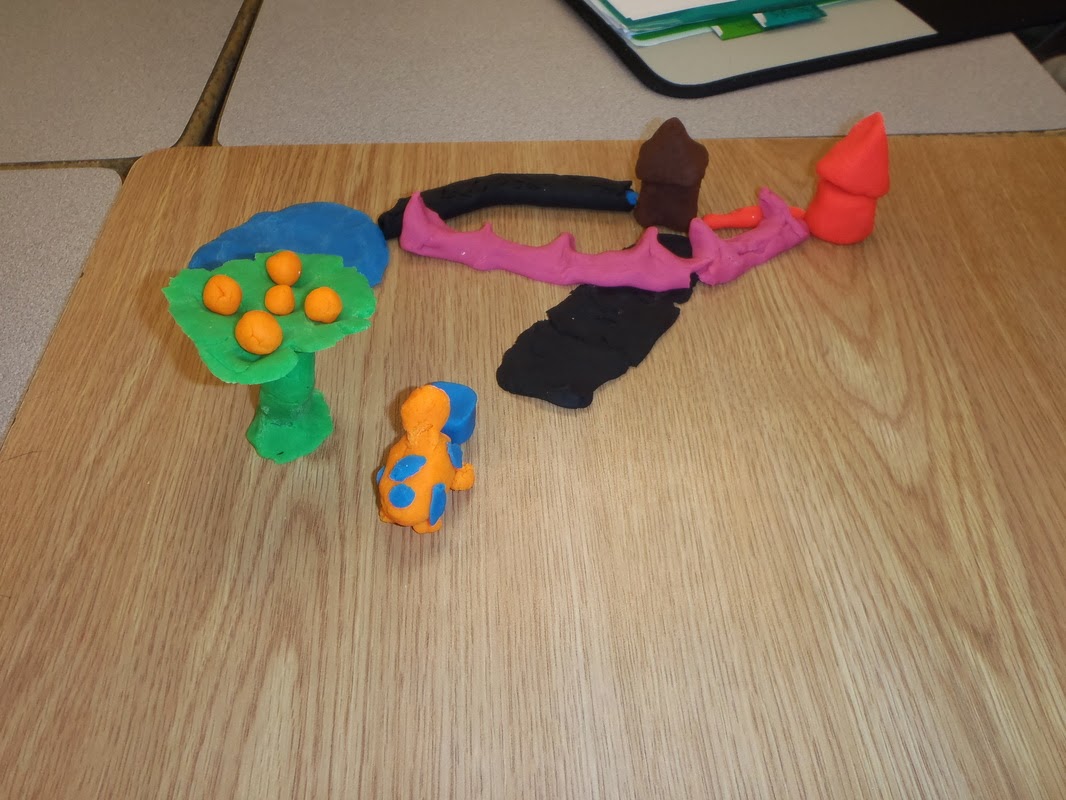
Post Courtesy of Lauren Vallis
Saturday, 19 April 2014
I Fought The Law and the Law Won

The Law society of BC loves schools! They even have a dedicated employee who works with interested schools to do tours of the courthouse, meet sheriffs, do mock trials etc.
Last friday, my social studies class along with some grade 7 classes attended the Penticton Court House for the trial of the century. Students were going to put the Big Bad Wolf on Trial for mischief, break and enter and willful damage to property. The Law Society has a scripted trial for the three little pigs that includes witnesses, sheriffs, jurors etc. Thus, students each receive a role and lawyers from town assist students with the entire process - for free! And they even provide costumes! In this mock trial, all we had to do was distribute scripts in advance and then get a bus to the courthouse. They even fed us a free lunch. Students were given a tour of the courthouse, a tour of the courthouse cellblocks, they met with sheriffs and lawyers and then got to go to a real courtroom for an official trial.

This activity is available to any grade level as well. Earlier in the day, Mr. Robinson from PMSS had been on scene with his law 12 class, re-enacting a trial where Luke Skywalker was being charged with murder for his role in exploding the death star. Unfortunately, Skywalker was found guilty on all counts. The Big Bad Wolf was acquitted of most charges, on a medical exemption due to his unfortunate case of hay-fever which had resulted in an accidental destruction of houses deemed not up to building codes.
Interestingly, the jury deliberated for 20 minutes. When teachers went into the jury room to determine why students were taking so long (the high school class took 5 minutes), the students were enthusiastically debating over the facts in the case and making supporting counter-arguments to each other. They eventually re-entered the courtroom as a hung jury. The judge was shocked and explained that the script did not account for that. The jury Forman then asked if the jury could re-deliberate. They did and eventually came back with a verdict. Students were abuzz during the entire process and enjoyed a task situation where they got to engage in a real process that many had seen on TV.
Field trips are something almost every student loves and they are sometimes easily available when we reach out to community partners like the courthouse. Imagine all of the other easily accessible opportunities for taking students outside of our four walls such as the courthouse, Police Station, Fire Hall, Eldercare centres, Elementary school, farms and factories. The list is extensive and so is the potential for rich learning experiences for our students.


Post courtesy of Louise Ganton
Tuesday, 15 April 2014
Tableaus and Technology: A New Twist On An Old Idea
Tableaus are something I've been using with Lit Circle units for a while. The idea comes from Faye Brownlie's book "Grand Conversations" (an awesome resource if you want to try Lit Circles in class). Tableaus are frozen scenes (like capturing a still shot in a movie). Students re-create a frozen scene from the novel they are reading that captures a key theme in that novel. In the past I have had students present their tableaus in front of the class, but this year I was short on time, and the novels are also testable material on the provincial exam (for English First Peoples) so I wanted something more permanent that the students could go back to for studying purposes.
Enter "Thinglink"- a web based program that lets you upload photos and then add interactive links such as text, video or audio. Instead of presenting the tableau in front of the class, each group (or set of partners) took a photo of their scene, uploaded it and typed in the explanations of the various elements of the scene. If you hover over the dots on the scene below you can see the explanation of the scene, the theme it represents etc. In the case of tableaus, "Thinglink" is very effective because it allows the students to add unlimited text without wrecking the picture- (where a program such as "comic life" would not be as effective because it leaves so little room for text). This program allowed me to keep all the benefits of tableaus (movement, visualization, creativity, collaboration) and let students record the information more effectively for long term memory and sharing purposes. I think this is a program that could work well in many different subject areas. If I really wanted students to present in front of the class, it could also become an option for students who were extremely shy and needed an alternative method of presentation.


For examples of traditional tableaus done in a Social Studies 9 class click on this post.
Here is an OUTLINE SHEET that students use to organize their ideas before they are allowed to use the cameras.
Enter "Thinglink"- a web based program that lets you upload photos and then add interactive links such as text, video or audio. Instead of presenting the tableau in front of the class, each group (or set of partners) took a photo of their scene, uploaded it and typed in the explanations of the various elements of the scene. If you hover over the dots on the scene below you can see the explanation of the scene, the theme it represents etc. In the case of tableaus, "Thinglink" is very effective because it allows the students to add unlimited text without wrecking the picture- (where a program such as "comic life" would not be as effective because it leaves so little room for text). This program allowed me to keep all the benefits of tableaus (movement, visualization, creativity, collaboration) and let students record the information more effectively for long term memory and sharing purposes. I think this is a program that could work well in many different subject areas. If I really wanted students to present in front of the class, it could also become an option for students who were extremely shy and needed an alternative method of presentation.


For examples of traditional tableaus done in a Social Studies 9 class click on this post.
Here is an OUTLINE SHEET that students use to organize their ideas before they are allowed to use the cameras.
Thursday, 3 April 2014
You are the Reason We are Here!
 |
I love to go visit
classrooms and see what teachers are doing. Just before Spring Break I
was in Lindsay Guza’s grade 7 classroom. I loved the message on the
door. Her philosophy was very evident to everyone. You are EXPLORERS!
That paints a picture of what learning will be like when I enter here!
You are respected, important and a role model, inquisitive, valued... and you
matter. And the last sentence… You are the reason we are here!
|
Knowing how much it matters
that students know their teachers like them, value them and have confidence in
them, makes this door a very important message.
There were other things in
the room that struck me. Lindsay shared some of the things she is doing
that are hands-on and thoughtful. She is trying to make learning more
interesting and connected with kids lives. Here is an activity that she
described:

ELECTRICITY
"I gave
kids sticky notes and they had to write down information they knew about
current electricity, static electricity, and atoms of electricity in
general. Then I asked them to come up and place them in the Venn diagram
where they thought they went. If they weren’t sure they placed them on
the outside of the Venn diagram. Then as a class we went through all the
ones on the outside and tried to see if they were in fact part of electricity
and needed to be in the Venn diagram or if they could stay on the outside.
I
also went around with pink sticky notes as the kids were working. I gave them
to a few of the kids who I thought needed more challenge; these sticky notes
had words that I thought were more difficult to place on the Venn
diagram." She described the activity as a great way to review the
concepts, check for understanding and challenge thinking.
blog
posted by Judith King with permission from Lindsay Guza
Wednesday, 19 February 2014
Professional Learning - Making Connections
I have recently become a “twitterer”… and I
am amazed at how that one small step has opened up a new world to me.
I pick up my ipad when I am too tired to do anything else, and the
next thing I know I am skimming articles about innovation, assessment for
learning, creativity, inclusion, belonging … or I am seeing pictures of
classrooms trying something new, or reading quotes. It is great professional
learning for me, and I am sometimes amazed at how interesting it is just to reflect
and think and make connections to all of the work I am involved in.
Through a Different Lens is a project about
innovation, creativity, relationships, and reflection on our own practice.
It is about our growth as educators and the growth of our students.
The project itself is school based, but many things happening in the
district and in the province are connected so closely with the work that we are
doing.
In the next two weeks alone we have some
great opportunities for all staff in the district that teachers in TADL might
like to take advantage of as they are all part of innovation, creativity,
relationships and reflection.
Edcamp Penticton: our very first
edcamp Thursday, Feb. 20, 3:30-6:00 at Pen High, where anyone interested will
meet for a few hours and share / facilitate sessions on current thinking:
assessment, behaviour, creativity, increasing dialogue . . . It will be a very
worthwhile time in terms of content, but also interesting for educators to be
exposed to a different way of sharing knowledge than the usual workshop format.
Come ready to participate. (register www.edcamp67.blogspot.ca and if it’s
already Thursday try just coming!)
Aboriginal book and video gathering, the 3rd
session for this year: We will be meeting to watch a NFB film called
"we were children" - a Canadian film on residential schools, at the
Maggie library on Tuesday, March 4, from 3:30-5:30. The book club connects so closely with TADL
and our work in school completion. Our book club is exposing all of us to
First Nations culture and issues through literature and film. It is
giving the adults in the district a safe place to talk and learn so that we in
turn can work with our students. (register atenning@summer.com or jking@summer.com or nsearcy@summer.com)
If you are looking for professional
development on innovation, creativity, inclusion, belonging, creating cultures
where everyone belongs - please join us at one or both of these events.
Post courtesy of Judith King
Subscribe to:
Posts (Atom)