Sunday, 26 January 2020

How can I use simple poems to build community and respect in our classroom?


 I always begin the year by teaching poetry.  We start with a simple simile, “I am as quiet as a feather landing on the grass.”  We learn together about each other through the construction of a variety of personal poems.


First Peoples Principles of Learning, “Learning requires the exploration of one's identity.”


BUILDING COMMUNITY AND A SENSE OF IDENTITY
We have learned through our Learning Maps, our class composition of our strengths and our stretches.  We know, as a class, before moving into this poetry unit who in our class needs support to write, to speak in front of everyone, to finish a task and to remain in class.  We pledge together to support each other.  We reflect on what support looks like, feels like and sounds like.  We built a community of trust and compassion.  We learn the Indigenous ways of listening with our hearts, minds, ears and body.  We train together to keep our mouths shut when our opinions and our thoughts are not kind or necessary.

This year, Marcus wrote, “I am as brave as a tiger.” This short poem impacts our class community in several different ways

1)  I know as a teacher that Marcus considers himself to be brave.
2)  We are supporting an inclusive model as we complete our first assignment in our home class by working together to help one another. 
3)  We are learning that we are all writers which supports the confidence that we require to continue writing for further assignments.
4) We support each other in spelling and grammar.  
5) We encourage others to share their own work out loud.  
6) We build the confidence to read our writing in a sharing circle. 
7) We collect all of our poems from different genres and make a poetry book with a decorated title page.  8) Together we practice and prepare for our Poetry Cafe.

POETRY CAFE
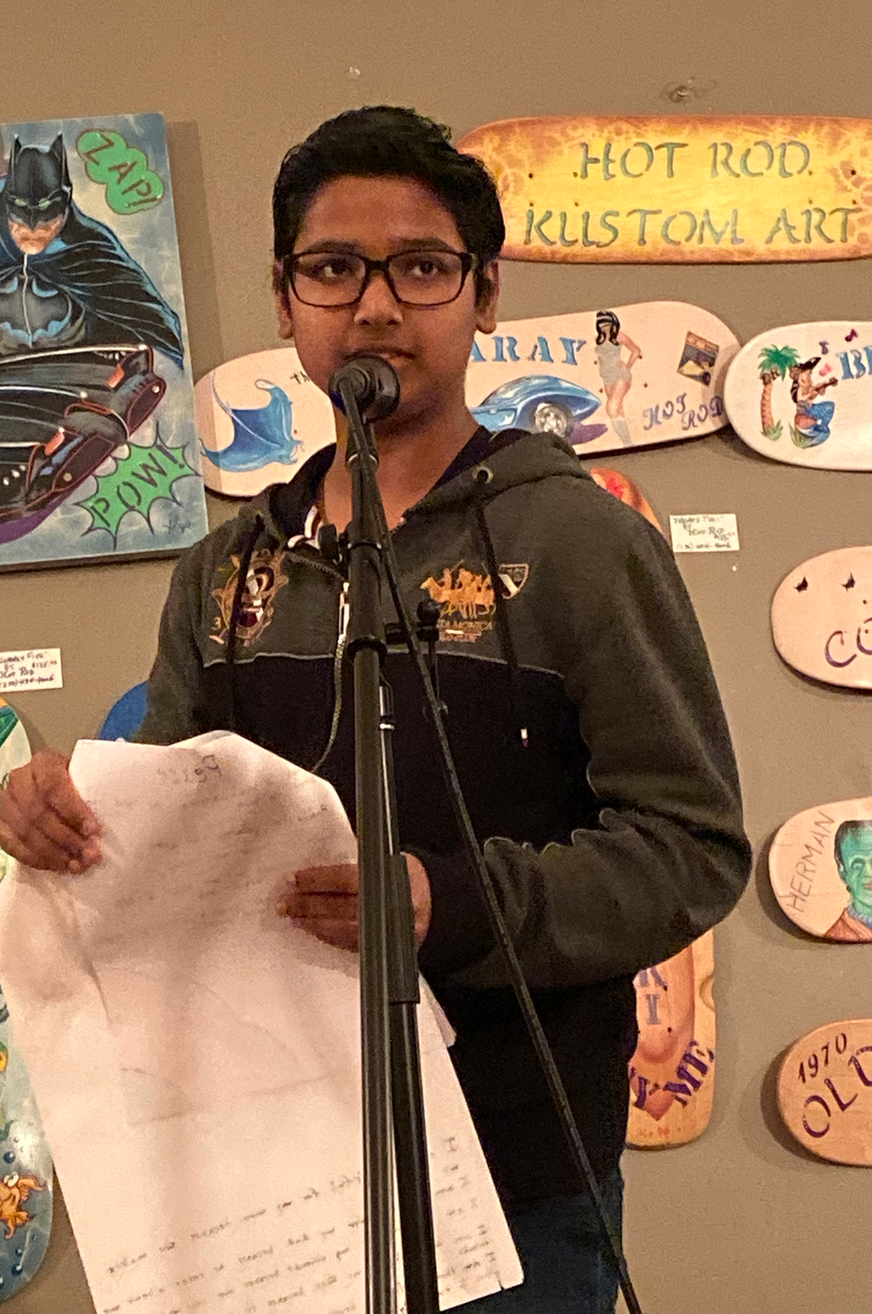
During an evening early in the school year, I book a cafe like the Craft Corner or the Nest and Nectar.  I invite the grown-ups in our class to come to the cafe for an evening of poetry.  As families arrive, I am able to meet them, learn their names, their family make up and hear some of their stories.  The learners find seats for their families.   They order tea, coffee and snacks and we listen to the learners as they go up to the stage one at a time and read their poems.  

At first there is always a reluctancy as it takes bravery, courage and a Growth Mindset to read what you have written out loud to others.  I believe teaching a Growth Mindset is an essential component of building a personal identity and something that learners need to succeed in their education and their lives.

As learners begin to read their poems and encourage each other, bravery grows among our class.  The more the bravery grows the more learners want to read and share their work.  One year on our poetry stage, a couple of learners sang a song they had written, this year Jaiden said good-bye to his Grandfather who passed away early in the fall.

By the time the evening has concluded I have had the opportunity to meet and connect with each family member in our class.  I have noticed interactions between family members, and I have learned who has siblings, grandparents and blended families.

AFTER THE CAFE
Once we are back at our class, I use the cafe as an example of grit and perseverance.  We have learned that some things we do at school are hard and that sometimes we have to try things we have never tried before.  We have learned to support each other in our writing, our reading and through some of our fears.  Together we have had a great deal of fun and accomplished a major task.

No marks are given for their 15 poems that we, including me, each write for our cafe.  The marks are not the point.  We have learned a great deal about one another, our families, our learning strengths, our stretches and like a well-oiled machine with all of the parts working as one, as a class, we have learned to become a team where no one is left behind.  

Blog by:  Corrie Goessman, Skaha Lake Middle School

Tuesday, 21 January 2020

Including All Learners at Middle School - Practices that Make a Difference

How can a Learning Support Teachers help classroom teachers include ALL learners at Middle School?

What happens when we start with student’s strengths?

I have been a Learning Support Teacher (LST) for over twenty years and have experienced a large shift in the educational community striving for full inclusion, which is the practice of including students with special needs in the regular classroom.  

In my current position as a Learning Support Teacher at Middle School, I support teachers in meaningfully including all students in the classroom.  So much of my job entails embracing the diversity in our classrooms by building a culture and framework that supports a safe and inclusive school community. Often, our learners that are vulnerable experience inequity in the education system through barriers to their learning.  With this in mind, strength-based practices offer a responsive approach to inclusion that reduces and removes barriers and ensures everyone has a sense of belonging, well-being, and access to learning in a safe and inclusive school community. 

Rather than removing individuals to special programs or segregated classrooms, we need to work on developing practices that connect those learners to the curriculum by addressing obstacles that might be impacting student learning and creating classrooms where students can use their strengths. Looking through our TADL data over the last 10 years, getting to know students and using their strengths in teaching and learning has made a big difference for kids.   The belief is EVERY child has strengths inside them and as educators it is our job to bring this out.  It is important to keep the learner at the center of our work.  Additionally, the more we know about our student's strengths and passions, the better equipped we are at building relationships and engaging our students.  
Here are some ideas for learning about student strengths that I have used in the past:
1. This is Me is a great way for students to share information about their strengths and interests.  (Schnellert and Brownlie)


2.  Student Profile - Shelley Moore also shared a one page student profile with our Inquiry Group.  It is written from a strength based approach from the student perspective.  I interview students that have IEP’s before his/her IEP meeting and the student shares this at the IEP meeting.  If the student is struggling sharing, we share it together or I share it with permission. If a student is unable to provide this information, family members can also be interviewed.  I found this approach to IEP’s helped inform the team about the supports a student would benefit from as well as gave student voice to the planning document. 


3. The Important Book by Margaret Wise -
The Important Book uses rhythmic words and vivid pictures to talk about what is most important about many familiar things -- like rain and wind, apples and daisies.  Students can use this frame as a way share their passions and interests.


4.  Identity Pictures:  Here is some examples f of students writing or collaging their strengths and passions as an art project.  The teacher took a picture of each student and photocopied them for students to use as an outline if they choose. Student strengths, passions and areas of interest fill their portrait. Students share their interests with each other as a way of connecting and getting to know each other.

Honouring how youth learn and creating an environment that promotes strengths values a child’s physical, emotional, intellectual and spiritual development in a way that creates an inclusive environment for all students.
For more information listen to this TedTalk by Chris Wejr on Strength Based Learning.  In this talk he tells about a some of his experiences early on in his career.

Blog post by:  Janice Moase, KVR School


Monday, 24 June 2019

THE INFRASTRUCTURE OF INCLUSION

All of us around BC are starting to realize that we never really know what is going to transpire when Shelley comes knocking on our door!


This time in SD67, Shelley and two of our helping teachers, Janice Moase and Shona Becker, led two great days for educators. On Day 1 they planned with a group of intermediate teachers in the morning and taught the class in the afternoon, and on Day 2 they did some dreaming and planning around two kindergarten students who have complex needs.

Two things happened on Day 2 that were unexpected and quite delightful.  First, the mother of one of the kids spent the entire day with us.  She shared her ideas, knowledge and dreams with us, not just for her son but for all kids, the school community, and the larger community in which they live.

The second thing was at noon on Day 2, Shelley decided there was just enough time to do a podcast involving Suzanna (the mom), Janice Moase, and myself.  And so we did it.  The podcast is available with this link.  It is called "The Infrastructure of Inclusion".  Listening to a few Podcasts over the summer is a great way to spend some time!

https://fivemooreminutes.podbean.com/e/infrastructure-of-inclusion-suzanne-janice-judith/


How fortunate we are to work with educators in our district who are open and wanting to learn, parents who are knowledgeable, supportive and appreciative, and outside voices like Shelley to share and plan with us.

Great two days.

Blog by Judith King

Wednesday, 29 May 2019

Innovative Schools: School Growth Plans WITH our Students

What a powerful evening at the final session of our Innovative School Series with school teams from SD67 and SD53.  This year one of our Through a Different Lens inquiry series challenged school teams to engage with their diverse learners as informants, co-learners and ultimately transformation leaders in making school goals and activities meaningful for everyone.  At our final evening of the series school teams shared how they used student voice to help them set goals, plan, take action, reflect on, and adapt their school growth plan - at the classroom and at the whole school level.

Throughout the series, schools offered ideas on ways they were listening to students - through interviews, daily work, surveys, forums, etc.  We had a number of students come and share in a number of our sessions.  But last night it just somehow all came together with both creative ideas and powerful stories.

We heard about 'passion profiles' at secondary where teachers can learn about the interests and passions of their students which allows them to begin conversations. We heard how important it is to listen to students who are in a place in their lives where school is not a priority because shelter, space, food, and love are, and how over time they become more interested in education and their future.  We heard about students delving into topics such as cyber bullying and mental health issues, crafting questions for further inquiry, and then going out and interviewing their middle school peers about these issues and trying to understand what others are facing.  Teams shared how they are conferencing with students to find evidence of the teachings they are exposing them to - risk taking, courage, and love - and how the responses they received helped them see students as knowledge keepers, not just knowledge receivers. We heard about kids not just having student voice but agency - participating in and planning activities and events important for their learning and that honoured and made a difference for others.  

Overall the theme was so evident - we learn so much when we stop and listen, when we plan and make space for students' insights, and when we change things once we have listened. 

The evening was powerful.


Big thanks to all who participated in SD67 and SD53, and supreme thanks to Dr. Leyton Schnellert who with great enthusiasm and energy asks important questions, prods us on, shows fabulous examples from throughout BC where things are happening, and fills us with the confidence that we too can do great things with our kids!  He reminds us that one of the most important things that we can do is nurture every student to speak on their own behalf, become experts in their own learning strengths, and develop the ability to communicate their insights.  It is our most diverse students who can help us transform education for all.

Blog by Judith King who is thankful for the planning committee:  Todd Manuel, Shona Becker, Marcus Toneatto, and Leyton Schnellert.


Friday, 3 May 2019

Something Magical: Intergenerational Learning


The following blog is from a teacher at middle school who took a risk and tried something in a different way.  Here, she highlights communication as an important competency for her grade 8 students.  She also writes so clearly about the area of social and emotional competencies and the surprises she has seen in this area.

This learning opportunity is also a wonderful example of the incorporation of the First People's Principles of Learning highlighting especially 'Learning involves generational roles and responsibilities',  'Learning ultimately supports the well-being of self', and 'Learning is holistic, and relational'. 


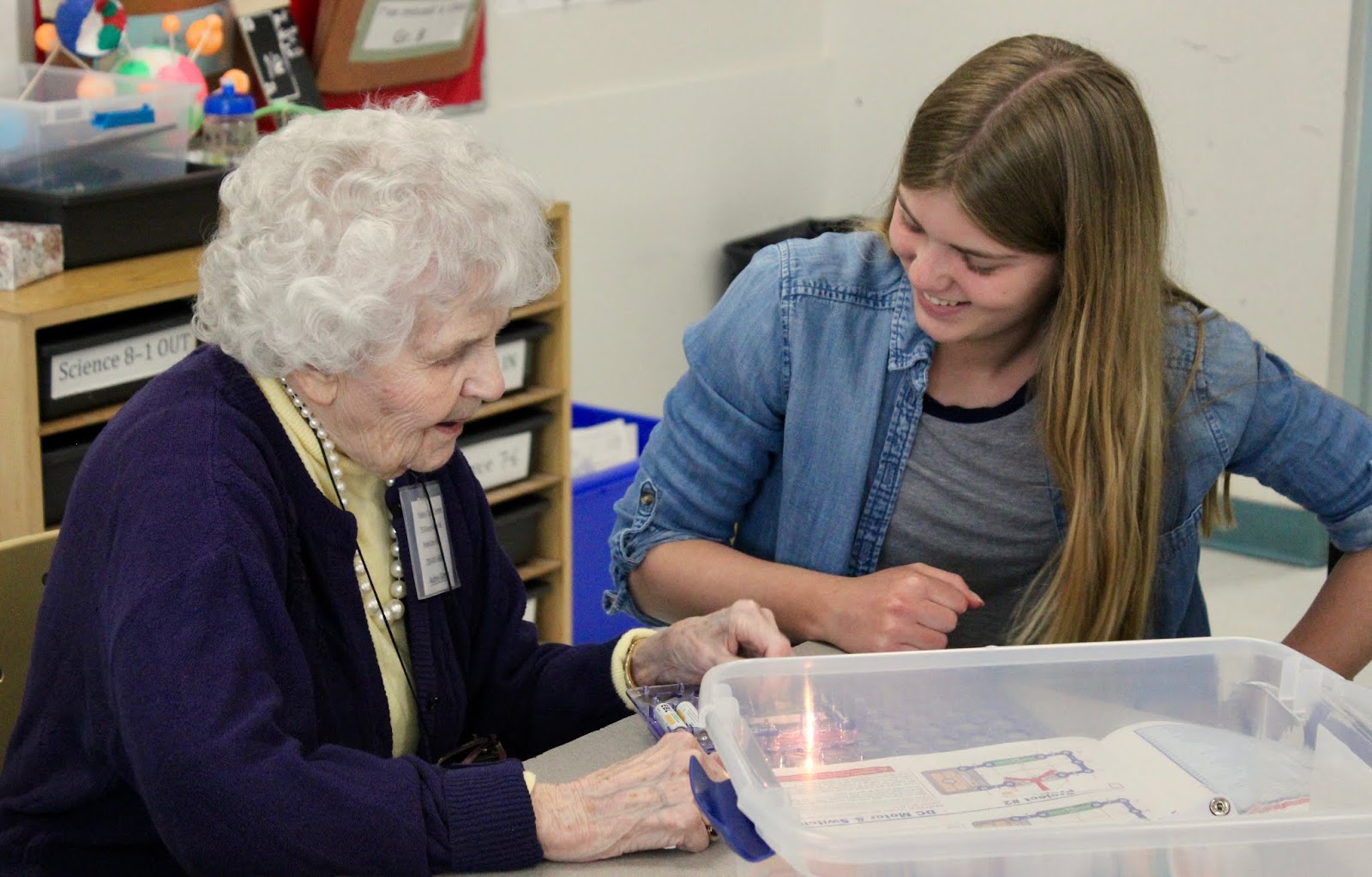
The pictures of the students and the seniors really tell a story. 


Navigating social situations and developing interpersonal skills at middle school is challenging, especially in an era when communication revolves around cell phones, social media, and virtual connections.  The chaotic energy and amped emotions that dominate middle school hallways leave little room for students to develop their face-to-face communication skills.  Meanwhile behavioural expectations in the classroom don’t usually allow for practice of communication skills that resemble those seen in a colloquial setting.  To help develop these important interpersonal skills our class partnered with some seniors from the Trinity Care Centre to form a rather unconventional, but successful buddy program.  

‘Who will hold the door?’, ‘How do I roll a wheel chair over a curb?’, ‘How many wheelchairs can fit in the elevator?’, were some of the questions tossed around as students readied themselves for their first hosting experience.  Instead of following a traditional visitation approach our class decided to host our seniors to a series of visits at our middle school.  Each visit took a different shape and varied in structure.  However, consistent throughout all visits was that the students were responsible for planning and providing care to their senior buddy.  The end result: an amaze-show.  
 
There is something magical that happens every time we bring the seniors over to our school.  It’s hard to explain the positive effect they have over everyone in the building: students and adults alike.  For that one hour a month, when the seniors are in the building, we all slow down.  We get out of our heads and ‘come down to the ground’ to connect with them. We lock eyes for a little longer, smile a little wider, and for that one hour…. we become the best version of ourselves. 

At the outset this partnership wasn’t intended to be more than a couple of visits with the seniors. However, due to the overwhelmingly positive response from the students we extended it until the end of the school year. 

Some unexpected outcomes of this partnership have included:
-      Seeing students who don’t participate in school come to life and fully engage
-      Learning that both students and seniors want to spend more time with each other despite initial feelings of nervousness (for both parties) 
-      Shifting student attitudes and perspectives to include a greater sense of appreciation and respect for the fascinating lives our buddies have led. 


A big thank you to this teacher.
TADL 2019

Tuesday, 19 February 2019

Planning for Inclusion

Earlier this month I had the opportunity to sit in on a planning session with grade 4 and 5 teachers who wanted to plan a cross curricular unit on the human body.

The session was led by Janice Moase and Shona Becker (helping teachers in our district) using some of the formats and planning sheets from Shelley Moore.  To be honest, Shelley was supposed to be with us but was sick, so we set out on an adventure to see how we would do without her guidance.  Janice has experience with the planning guides and Shona is an amazing science and math teacher, so we were in good hands.

Planning a Unit Accessible for ALL


The goal in these sessions is to build a unit that is accessible to ALL.  That means choosing your content and curricular competencies goals and then finding the access point by looking at the students in your class - the starting point where EVERY SINGLE STUDENT can succeed.

Everyone begins together.  
 
There is a lot of power in beginning together.  It involves thinking a bit differently and planning a unit starting with what everyone can do… Planning for ALL.  Then looking at what is slightly more complex that MOST will do.  Then looking at more complexity - what a FEW will do. It means planning for the kids you know - but not planning to keep those kids in any box.  ALL options are open to ALL kids.  Planning this way means you are not planning a unit and then retrofitting for those who need more support and more challenge.  EVERYONE begins together - and while some kids continue to work on the initial goals, others move on to the next layer of complexity.

It is different work - it means looking closely at the curriculum and your kids and then thinking creatively, trying to build an inclusive, interesting, creative, fun, motivating, engaging unit where everyone can participate - all learning the same content and using the same processes (competencies).

The teachers decided to look at inquiry based learning to drive their unit.  They created the following overarching question as their BIG idea:

How can you use language in creative and playful ways 
to show how body systems interact with each other?

The main content and curriculum competency goals:


And here is the ALL, MOST, FEW triangle where it was decided what ALL can do, more complexity for Most, and then even more complexity for FEW.


First Lesson:  the HOOK


We planned all morning, then in the afternoon, Janice and Shona co-taught with the classroom teacher, Kristina. This first lesson was the HOOK for the unit.  As a group, the students watched short video clips of hearts and lungs, diseased and healthy, and were asked to think about and comment on what they 'wondered' and what they 'noticed'.  Following the video provocations and group discussion,   there were six tables of invitations/provocations set up in the classroom.  Students spent five minutes at each station with a short report out to their small group at the end of each station.

1.  Observing a moose heart and bones.  What do you notice?


2.  Explore books to get an idea of what you will be learning about… what did you find?  

3.  Maker:  Build what you know about your digestive system


4.  Time your resting and active heart beat and record; or help someone record theirs.


5.  What systems can you find as you put together these images?  What do you think they are?


6.  Maker:  Build what you know about your bones and muscles


This is the renewed curriculum, that has moved from a standardized approach to a standards based approach.  ALL kids are learners.  There is room for EVERYONE.   

Thanks to teachers at Giant's Head and Janice and Shona for a great planning session, and to Shelley for her guidance over the past few years.

Submitted by Judith King