Monday, 2 June 2014

Stop Motion In History 12

A colleague introduced me to a free app (Stop Motion-Animation Maker Pro) that allows students to create video-esque 'flip books' using white boards, markers, and either a tablet or smart phone.  Their assignment was to select a portion of WWII history and create a short video with voice over that demonstrated their knowledge of a particular battle.

The app itself is relatively easy to use, although I must admit that many of my students navigated through it and learned its nuances more quickly than I!  

The progression worked like this:

1.  After selecting a topic (in the example posted, this student chose the Battle of the Atlantic), students are to make use of their notes from previous lessons along with any other information available (texts, internet sources, etc).  

2.  Using a white board and markers, students draw a series of simple illustrations, taking a picture using the stop motion app, of each illustration.  Illustrations are to vary slightly in degree from one frame to the next.  The stop motion app has an 'onion skin' feature that allows for adjustment of the opaqueness of the camera filter, so that students can see the previous picture under the new photo taken.  This allows the photos to be lined up in order to create that 'flip book' effect.


3.  Once their pictures are drawn and photographed, students are then to record a voice over of information relevant to the images they have drawn, but also including other pertinent details that perhaps couldn't be illustrated.


The final products were excellent with some students drawing very simplistic figures, like the stick figure you see in the image above, while other more artistic students took more time to descriptively depict the scenes they imagined from their chosen WWII conflict. 

Here is a selected piece of work:


 Post courtesy of Lesley Lacroix 

Sunday, 1 June 2014

Creating for an Authentic Audience

Last week the Penticton Art Gallery hosted an opening night for an exhibit of work produced by local high school students. The Princess Margaret selection from Brad Gibson's art classes included 3 sections: A mask project (Grade 9/10) A Tea Pot Project (Grade 11/12) and a set of Dry Point Etchings (Grade 11/12).

Brad commented that there are many advantages to exhibiting the student work in a public forum. "It takes the projects out of the context of the classroom and puts them into the professional environment of the art gallery," he said. Students see their work from a different perspective and in a formal display which signifies respect. They also get to observe other members of the public appreciating and discussing their work. Students were aware before they began their projects that these would be going on display at the gallery, and though any work performed by Brad's students is of a consistently high quality, the expectation of a public show was an added incentive for students to take the work extremely seriously.

A second benefit Brad mentioned was that the exhibit allowed him to showcase the wide range of students that choose to take art at Princess Margaret. Students are allowed to enter the art program during any year of their high school career, and with any level of experience. The display showcased the extraordinary products produced by a very varied group of students. After the opening night students were extremely positive about seeing their work on display and valued by members of the larger community. Opening night of the exhibit was well attended and many parents also commented on the value of seeing their child's work on display in a public forum. It was a great reminder of how important it is to provide students with an audience for their work beyond the perspective of the regular classroom.

The show runs until June 15th.


Tuesday, 27 May 2014

Atomic Play-Doh (Science 10)


I tried a different activity with students in Science 10 the other day using Play-Doh.  Instead of having the students go through the traditional method of learning nuclear fission/fusion with sketches and nuclear equation notes, I had the students use Play-Doh to model the reactions.
 I was hoping that something tactile such as physically making electrons, protons, neutrons and making the isotope models when constructing the nuclear equations would engage some less motivated students more than the traditional pencil and paper way.  The results were positive.  Although some students worked slowly,  the modelling forced them to discuss the terms and associate the colours of play-doh with the nuclear particles they had associated them with.  This allowed the students to "play" and learn at the same time.  Interestingly, the activity had a wide range of effects on the whole class. Strong academic students started teaching the other students the equations.  Students shared ideas and corrected each other as they worked through the activities.  Some students inquired about whether the atoms needed to display the electron shells.  This further allowed students to use the play-doh to model electron shells and Bohr model diagrams. The activity was a pleasant surprise.  All students participated and there was a significant level of inter-student discussion as well as peer coaching and teaching. I will try it again.


Post courtesy of Cory Hogg 

Sunday, 25 May 2014

Elementary & Middle School Highlights

Here are some of the 2013-2014 highlights collected this year from our Elementary and Middle School teachers.


Tuesday, 6 May 2014

BC's Economy: Agriculture

Social Studies 10:  Wild Goose Winery 


One of the focuses during Social Studies 10 is on British Columbia's economy and the major sectors that make up BC's economy. For our look at agriculture we discussed different agriculture based activities such as ranching and crop farming. We focused primarily, however, on the Okanagan based activities of orchards and vineyards. With recent discussions in the media about the Agricultural Land Reserve we were able to identify reasons why the ALR is both positive and negative for farmers and the general population of BC. This enhanced students understanding about the need to promote farming, not only in Penticton, but throughout the province. As part of this unit we looked at parts of three different documentaries, No Impact ManEnd of the Line and Dirt. During the documentary Dirt, students were given multiple looks at how dirt provides humans with the basis of all life on the planet and how through constant development we are negatively impacting so much of the dirt on our planet. One of the parts that stood out for most students was when a winemaker in Italy bent down and tasted the dirt. The winemaker said that he can taste many of the flavours of the wine in the dirt. This clip peaked students interests and led us to a field trip to a local vineyard in OK Falls.

On April 28th, along with Naryn Searcy and Christy Bevington, my class went to Wild Goose Winery for a tour of the vineyard and wine making facilities. For many of the students it was their first time in a vineyard. Throughout the tour our guide, owner Roland Kruger, discussed the impact the dirt had on the growth of his grapes and how simple things like a higher abundance of rocks in one area, or clover in another impacts the flavours that winemakers will produce. Roland helped us understand the farming methods that are used at his vineyard, including watering cycles and pruning methods. One of Roland’s greatest fears is that there is a limited number of young workers entering into the field of work. As Roland said, the young energy that these workers can bring to a growing industry can really help make the Okanagan market flourish. Our students were exposed to not only the agriculture of the vineyard, but also the marketing and tourism of the winery.

At Wild Goose Winery our students saw the full process from growing to shipping a finished product. Many of the students in my class are very hands on, the opportunity to pick up pruned vines and touch oak barrels full of two year old wine allowed them to connect the process. A highlight for all students was the opportunity to see the bottling room and the machinery required to produce the 14,000 cases a year that Wild Goose sells each year.

The winery tour allowed our students to see agriculture in action. By having an opportunity to put together information from the textbook, from class discussions and from a field trip, students were able to connect with the topic in a deeper manner. Having just written our test, it was evident that students understood agriculture much more than say another topic like mining which can seem quite foreign to many students in Penticton. As with most new learning opportunities there are things that can be adapted to still provide a richer learning opportunity, but overall this was a very big success and will hopefully be one of the better memories for students in my Social Studies class.


Blog post courtesy of Bo Boxall
Bo's inquiry question: If we offer students multiple outdoor learning activities how will affect student engagement?

Sunday, 4 May 2014

The WALLS have EYES, EARS, and INFLUENCE

I've spent a fair amount of time in Skaha Lake Middle School recently and also visited Columbia Elementary and am always interested on what is on the walls. Last year, I taught in a room now occupied by Lindsay Guza and I must admit, she has done a far better job with renovations. Her walls are alive with student work and ways for students to learn!  

It got me thinking about the ways our walls can be used to teach. In Lindsay's case, there are a few new things at play. First, there is a learning component, with notes pasted around the room for a recent unit of study. Next, there are science fair projects from previous years, meant to inspire students during ongoing work they are doing. Third, there are cool biology projects that showcase student works. Fourth, in a cross-curricular style assignment, students have demonstrated art skills and academic skills as they've drawn excellent pictures of organs. These all add to a vibrant sense of classroom community and learning.  


Judy Schneider is a colleague who is also great at building community. Every time I go to visit, she's like the fairy-godmother, with kids abuzz around her. Of the myriad of ways i've seen her build community is also on the walls of her classroom. Each student gets a poster in Judy's class. On the poster they get to draw a picture of themselves  and they get to list three wishes and a star (three things they hope for and one thing they want to work on throughout the year.).  It is awesome as they can reflect on their goals and constantly look up and see their own potential. What a cool way to build community and to showcase student values and goals. 


Once in awhile a student will come in and ask about a poster on my wall. Over time I usually forget the posters and they become part of the background. However, once in awhile I am reminded of the power of decorations and what we hang on the walls. A police friend of mine recently came to my class to visit and do some community policing (a term for meeting with students and answering questions in order to build rapport with the community.) When he arrived, many of his questions were about he posters of World War 2 that I had up around the room, or about the student work pasted on the walls. It made me realize that students likely see and wonder the same. 

Judith King gave me a map of First Nation's territories last year and I put it up near the doors so that as students leave, it is in a place of prominence. It is also near the front so I can reference it in Social Studies 11. Two students of First Nation's  ancestry noticed it right away  last semester and were enthusiastically showing me what Nations they had in their ancestry. They also taught me some correct pronunciations and mentioned that it was important that I had it up; but also wondered why. They were also intrigued by the fact that the map had some teaching ideas on it.

Visiting colleagues has made me reflect again on the power of the periphery. These items are peripheral to teaching (more so in the high school) but what impact do they have? Should I put statements of values on the class wall? Should I showcase posters of content? How much student work should adorn the walls? How often should posters/student work/pictures be mover or changed to stimulate learning?  Thanks to Judy and Lindsay for making me think about how to decorate my room to maximize learning. 


Post by Jeff Fitton with permission from Lindsay Guza and Judy Schneider

Wednesday, 30 April 2014

Play-Doh Sim City

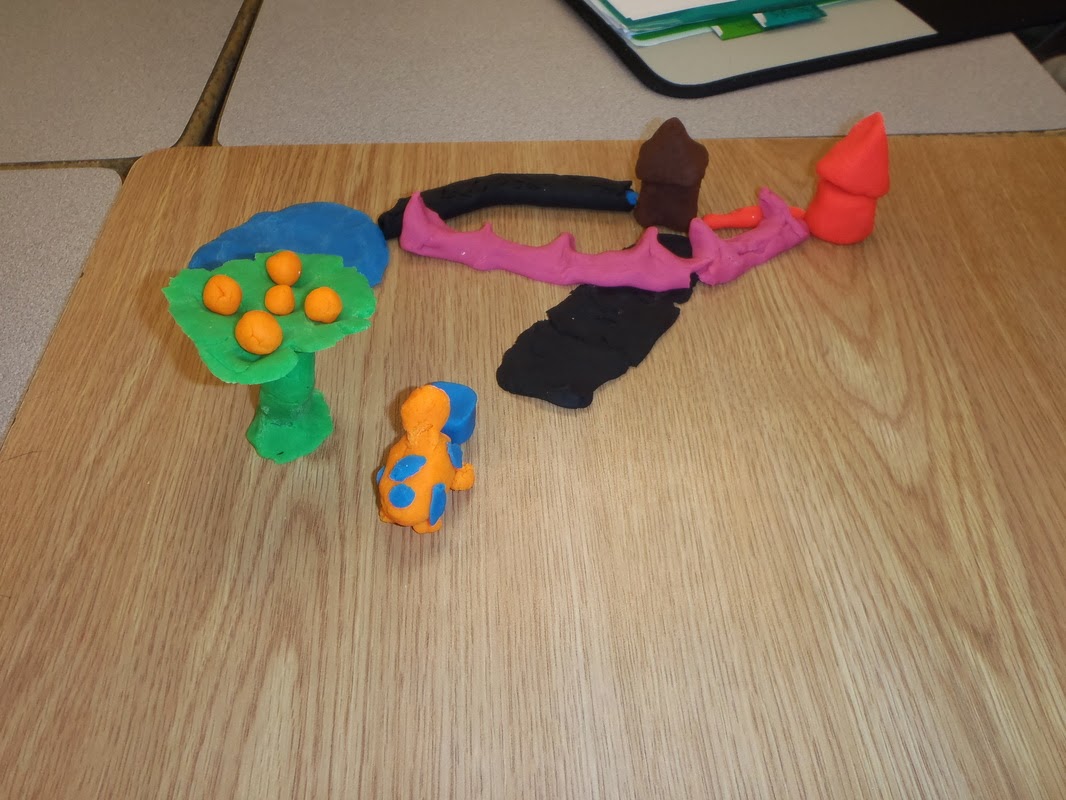
As an introduction to the Geography of Ancient Rome, we first discussed the game Sim City.  I asked students what they needed to put in their cities to make them flourish.  Then, in groups, I had them brainstorm the most important features that they would need to include if they were going to build a city from scratch.  Their goal was to narrow it down to five of the most vital components.  They then had to build their cities out of Play-Doh and together, they had to write a paragraph that explained why they chose each of those five things and why they were important.  Their paragraphs were excellent!


Post Courtesy of Lauren Vallis

Saturday, 19 April 2014

I Fought The Law and the Law Won

Often with teaching, there are great opportunities available to partner up with community groups who love to work with schools. However, with the busy schedules that we have, it can be difficult to search out community partners and take advantage of rich opportunities.

The Law society of BC loves schools! They even have a dedicated employee who works with interested schools to do tours of the courthouse, meet sheriffs, do mock trials etc. 

Last friday, my social studies class along with some grade 7 classes attended the Penticton Court House for the trial of the century. Students were going to put the Big Bad Wolf on Trial for mischief, break and enter and willful damage to property. The Law Society has a scripted trial for the three little pigs that includes witnesses, sheriffs, jurors etc. Thus, students each receive a role and lawyers from town assist students with the entire process - for free! And they even provide costumes!  In this mock trial, all we had to do was distribute scripts in advance and then get a bus to the courthouse. They even fed us a free lunch. Students were given a tour of the courthouse, a tour of the courthouse cellblocks, they met with sheriffs and lawyers and then got to go to a real courtroom for an official trial. 


This activity is available to any grade level as well. Earlier in the day, Mr. Robinson from PMSS had been on scene with his law 12 class, re-enacting a trial where Luke Skywalker was being charged with murder for his role in exploding the death star. Unfortunately, Skywalker was found guilty on all counts.  The Big Bad Wolf was acquitted of most charges, on a medical exemption due to his unfortunate case of hay-fever which had resulted in an accidental destruction of houses deemed not up to building codes.

Interestingly, the jury deliberated for 20 minutes. When teachers went into the jury room to determine why students were taking so long (the high school class took 5 minutes), the students were enthusiastically debating over the facts in the case and making supporting counter-arguments to each other. They eventually re-entered the courtroom as a hung jury. The judge was shocked and explained that the script did not account for that. The jury Forman then asked if the jury could re-deliberate. They did and eventually came back with a verdict. Students were abuzz during the entire process and enjoyed a task situation where they got to engage in a real process that many had seen on TV. 

Field trips are something almost every student loves and they are sometimes easily available when we reach out to community partners like the courthouse. Imagine all of the other easily accessible opportunities for taking students outside of our four walls such as the courthouse, Police Station, Fire Hall, Eldercare centres, Elementary school, farms and factories. The list is extensive and so is the potential for rich learning experiences for our students. 


Post courtesy of Louise Ganton