Saturday, 27 February 2016

Stories

Two full days of professional development .  What incredible learning opportunities were offered.  Leyton Schnellert and Shelley Moore talked about inclusion – but it’s always much more than inclusion as we might traditionally think about it.  They wove in:
- The new curriculum 
- How to teach SEL within the context of a series of lessons
- How to teach with all kids in mind
- The First People's Principles of Learning
- Story – your story, each child’s story, and how to collect multiple stories

The idea of STORY is a powerful thing.  We can learn so much from hearing stories. Shelley shared about ‘snapshots’ – how we need to collect more than the ‘snapshot’ we get of our students to see what is really happening; Leyton told us stories of two boys and what happens when you teach to their strengths, adapt things slightly to empower them.  We heard about the ‘wind’ – how we can’t control it but we can channel it to do wonderful things.

In addition to Shelley and Leyton, Naryn Searcy shared about seeing our students who challenge us the most as ‘trickster students’; these are the students who teach us, change us; we become better teachers because of them; and Myron Dueck told a story about using the 2 x 10 strategy as a vice principal, not a classroom teacher, with a student in the hallways, the discomfort and the changes he saw.


We can not connect with some students without the story, or at least some of the story, or at least showing we are open to the story; the connection with our students – especially those who may not be connected with any other adult in the building, is the most important factor in keeping kids in school and engaged in a meaningful way.

Monday, 18 January 2016

Provocations

A few of us from SD67 have been attending an inquiry in SD53.  A group of early learning and primary teachers led by Melia Dirk have been meeting together to talk about provocations, and how to build classrooms that foster inquiry.  At this last meeting, teachers shared how they have used different materials to stimulate play, curiousity, writing, building and story.  We saw examples of tables covered with nature materials, shells and sand, jewels, animals, art supplies.  Some teachers put the materials on mirrors or light tables to add different kinds of exploration.  Other teachers used story stones to stimulate writing and story telling; one teacher is taking her class outside every Wednesday to explore nature and write about it. Last week her students investigated animal tracks in the snow. 
 
Nature materials in a Strong Start Classroom


Materials used to stimulate connections and memories


This kind of learning has been around for a long time in many pockets in the world, and is certainly becoming more evident in classrooms around B.C.  The provocations that SD53 are exploring are based on the Reggio Approach, which is being explored in districts throughout B.C. Many teachers are visiting the Opal School in Portland to see it in action.

“The Reggio Emilia Approach is an educational philosophy focused on preschool and primary education. It was developed after World War II by a teacher, Loris Malaguzzi, and parents in the villages around Reggio Emilia in Italy. Following the war, people believed that children were in need of a new way of learning. The assumption of Malaguzzi and the parents was that people form their own personality during early years of development and that children are endowed with "a hundred languages" through which they can express their ideas. The aim of this approach is teaching how to use these symbolic languages (eg., painting, sculpting, drama) in everyday life. The program is based on the principles of respect, responsibility, and community through exploration and discovery in a supportive and enriching environment based on the interests of the children through a self-guided curriculum.

When I watched some of the video clips from the Opal School I was intrigued with how well it connects with Through a Different Lens; Younger kids, but a similar approach.  Opal School seems proud that they are addressing the needs of all students – and doing it by allowing them to express their learning in many different ways. That sounds very familiar to many in SD67.

We are in an exciting time in education - so much to learn and be curious about ourselves.

submitted by Judith King


Wednesday, 2 December 2015

Indigenous Perspectives: Where To Begin?

Educators in British Columbia are recognizing that Indigenous perspectives are an integral part of the new curriculum. While teachers are excited by these changes, many also harbour some anxiety. How will they weave Indigenous perspectives throughout their lessons, instead of treating them as an "add-on"? How should non-Aboriginal educators respectfully and appropriately incorporate Indigenous ways of knowing into their practice? Students in classrooms that reflect First Peoples principles describe their learning as relevant, active, and engaging. They become more open to diverse perspectives, develop the ability to creatively solve problems, and enjoy a supportive community with their classmates. Students learn to see the connections between their education and the world around them; they recognize that the world around them is their education!

No matter what the subject area or grade level, incorporating Indigenous ways of knowing and learning allows students to connect more deeply with their educational experience. Here are three recommended starting points for educators who would like to increase their understanding of these perspectives:

1. The First Peoples Principles of Learning
Described as one of the founding documents of the new B.C. curriculum, the First Peoples Principles of Learning (FPPL) were created through a joint partnership between the Ministry of Education and the First Nations Education Steering Committee (FNESC). The FPPL are a set of learning principles based on general Indigenous educational perspectives and are a wonderful framework to guide any educator hoping to learn more about First Peoples ways of knowing.

A key companion piece to the FPPL is Jo-Anne Chrona’s website which goes into each principle in more depth, provides context for what each might look like within a classroom setting, and includes links to the new BC curriculum and competencies.  This comprehensive resource also provides connections with non-Aboriginal educational theory and includes tips for using authentic resources and avoiding appropriation.

2. Your school district Aboriginal Education Team: While districts vary in the structure and size of their Aboriginal education programs, members of your district’s educational team will be able to recommend resources, connect you with members of your local community, and
guide you in ways to implement Aboriginal perspectives into your practice.

3. FNESC (First Nations Education Steering Committee)
The FNESC website has a wealth of resources. The “First Peoples Classroom” tab provides links to authentic resources as well as recommendations for multiple grade levels and subject areas. FNESC also offers a variety of workshops and conferences around the province.

It’s an exciting time for education in B.C. and a highlight is the Indigenous perspectives now embedded throughout the K-12 curriculum. While there will obviously be challenges that accompany any type of significant change, these new elements will provide our children with an educational experience that accurately reflects our dynamic and diverse 21st century society.

Additional Resources:

Aboriginal Perspectives and Worldviews in the Classroom: Moving Forward (Ministry of Education)

Friday, 20 November 2015

When Art Meets Life: Connections with the Community

When the world famous Cirque du Soleil arrived in Penticton last spring, they offered the Pen-High senior art program an opportunity to help promote their show Varekai.  Senior art teacher Shauna Reid leapt at the opportunity to provide her students with the authentic challenge of taking on a marketing campaign for a very large production. The students decided to redesign their watercolour unit around the Cirque du Soleil show, and students based their paintings on the characters and costumes involved.

Not only did the students design promotional pictures but they also hosted a media event at Pen-High where both local newspapers, a radio station and Shaw Cable took photos and interviewed the students. The paintings then went to the local mall where they were on display for the week before the show. Reid said the project allowed the kids to learn about several angles of the art business including how to market a show, how to correctly frame professional work and all of the organization it takes to create a display for the general public. It was an exciting but daunting challenge. With any authentic tasks comes the anxiety of attempting something with no guarantees of success. 

When the show actually arrived in Penticton, the art was moved to the local venue (the South Okanagan Events Centre) for the duration of the performances.  The watercolours proved to be a perfect complement for the bright energy and whimsy of the show's themes. In return for all their incredible work, the students received free tickets to the opening night performance. Two students even sold their paintings to the Events Centre and it was a memorable experience for all involved. Some students had never even been in the Centre before. The icing on the cake was when the Cirque company donated all the frames for the artwork which the Pen-hi art program now has available for future shows. 

While the end result was a positive and memorable experience, it required a willingness on the teacher's part to take a risk and make some significant adjustments to previously planned lessons and schedules. Reid did not know that the Cirque offer would happen during the semester, but she found a way to make sure her students did not miss this invaluable opportunity to create art for an authentic purpose and a real audience.

Click on the slideshow below for more examples of student artwork.

Tuesday, 3 November 2015

I Love Inquiry

We have started four new inquiry groups this fall under the umbrella of Through a Different Lens: Inclusion, Indigenous Practices, Assessment and Grading, and Literacy.  Most of these groups are K-12.  All of these groups are looking at teacher collaboration through the inquiry process with a focus on teacher practice and also a focus on how our practice effects our learners  who are most at risk of not completing school. We are now in our 5th year of Through of Different Lens.  It has morphed and changed and grown as we have changed and learned.  We have listened very carefully to teachers who have been part of the project, and to the students who are in those classrooms.  We have constantly adjusted and reexamined how we are doing things.
Our overall goals have stayed the same:  How do we remove the barriers to success that many of our vulnerable learners face and capitalize on student strengths by allowing them to choose a method of  both learning and representing that is aligned with their interests, cultural background, talents and strengths.  We continue to focus on engagement and community.
 
So far this fall, I have had the good fortune of attending four inquiry sessions in the various groups that fall under the TADL umbrella.  I have been struck with what I would say is a real optimism about our kids that have found school difficult, and a real hope for what we as educators can accomplish.

 I have heard comments such as these:
“I can teach ALL learners in my classroom”,
“I can find an entry point for every  one of my students”,
“I am wanting to find ways to help this child while still maintaining his dignity”,
“I want my student to connect with his heritage”
“I want this child to be MEANINGFULLY included”,
 “I want to weave Aboriginal principles throughout the curriculum so ALL my kids learn”,
“I want to assess the exciting things that we are doing in authentic ways”.    
“I want the students to be more involved in assessing their work and learning from it”

I love inquiry.  I love seeing eyes light up as we realize we are not alone in trying to figure things out.  I love when teachers ask if they can be part of more than one inquiry because they are so excited to learn more.  I love listening as teacher share their thinking, their ideas, their time and their concrete examples freely with each other.  This is what learning is all about and where education is such a rich and complex and exciting place to be. 
Submitted by Judith King, Helping Teacher - School Completion

Saturday, 18 April 2015

Cross-Curricular Adventures

Melissa Berrisford wanted to give her grade 9 social studies class an active experience to learn about the fur trade era, but she didn't have the time or resources to create what she needed. John Buckley's senior Adventure Tourism class was looking for opportunities to apply their learning in situations that would replicate future employment scenarios.

The solution? Melissa "hired" the Adventure Tourism (AT) students to design an outdoor experience for her class that would allow them to actively learn about the fur trade in an outdoor environment. The AT class chose an appropriate location for a miniature Hudson's Bay trading post, built the post, designed various activity stations for the grade 9 students, surveyed and marked a trail into the fort, and practiced various roles that they would occupy when the grade 9s arrived.

Building the trading post
When the Grade 9 students reached the head of the trail they were greeted by their guides (International students who refused to speak English). The grade 9 students then had to communicate and barter with the guides so they would lead them to the trading post. Once there the students participated in various stations (run by the AT students) including the trading post, the fire pit (aka food station), and the games/activities station (slingshots and target throw).

Hiking the trail up to the post
As the grade 9s rotated through the stations they had a chance to experience some elements of the lives of the voyageurs. A highlight for many students was the trading post itself where they traded items they had brought from home for other items brought by the grade 12s.

Striking a bargain in the trading post

The ever popular fire pit station
Sling shot station
Reflections from students revealed that they had connected with the experience in valuable ways:

"The hike into the trading post camp reminded me how dependent the explorers were on their First Peoples guides. We had no idea where we were going and we had to completely trust them" 

"Today gave me a better experience of what explorers had to live through"

"It really put the voyageurs' journeys into perspective because I never realized how many frustrating feelings and hard thinking went into trading for goods"

"I will really remember the experience of trading, the mental picture of the camp with all the wood structures and the fire pit, and the tiring, focused hike."

The overall response from the grade 9 students was that the experience was valuable and memorable. The only consistent complaint was that they wanted to stay longer. Of course, the trip was only made possible by the creativity, planning, and physical work of the Adventure Tourism class, which is a reminder that we sometimes forget about one of the most powerful learning resources in our schools: the students.

Sunday, 15 February 2015

The Blanket Exercise

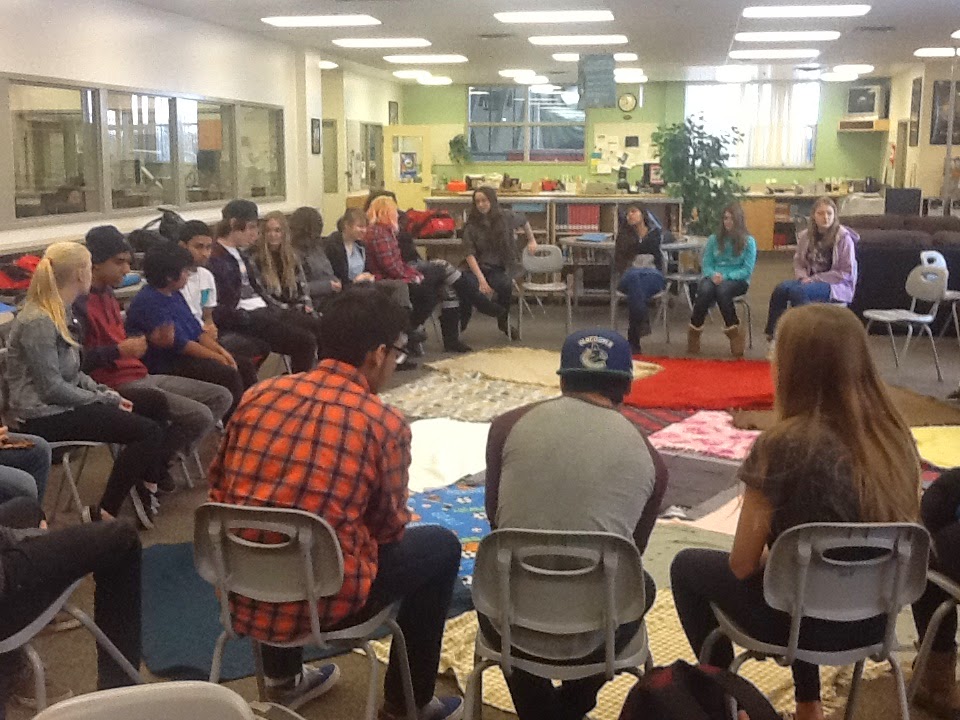
The Blanket Exercise is a visual and interactive way to help students understand the devastating impact of colonization on Canada's Indigenous population. Students begin in a circle with numerous blankets spread out in front of them. The blankets represent Turtle Island (the land mass of North America).


The students themselves play the role of the Indigenous people throughout the activity. They begin by spreading themselves out over the blankets, representing the Aboriginal population before European contact.


Students are then taken on an interactive journey through history. This journey includes various events that profoundly impacted Canada's Aboriginal population including the introduction of disease, the Indian Act and residential schools. By the end of the lesson, students have a powerful visual understanding of the reduction of land and rights for Aboriginal people in our country. 

The exercise is followed up with a class sharing circle where each student has a chance to express what they have learned from the experience. Many students describe how the activity was much more powerful than learning about these events "from a textbook". The Blanket Exercise involves movement, continual student participation and strong visual elements which make it engaging and memorable.  In SD 67 the Blanket Exercise has now been shared with numerous classes by our district Aboriginal Education team who lead the class through the role playing exercise. The examples here are from Christy Bevington's grade 10 social studies class but there is also a shorter version of the activity available for younger students. 

Sunday, 26 October 2014

5 Photo Stories

Today's lesson was a combination of three separate ideas. The first I learned at my 5 day writing workshop last summer with Richard Wagamese. On the second day, Richard gave each of us a random object and we had one hour to create a story that involved the object and then present it (orally) to the group. He explained that "every object and every person has a story". The second idea came from a lesson I observed on my teaching practicum. I observed a film class where the teacher gave each group of students a prop (in this case they all got an apple) and gave the groups the entire class to create a film designed around the apple. The students came back and showed their short films at the end of the class. The third idea comes from the 5 card story project on flicker where people are given 5 random 
photos and they need to make up a story. I was introduced to this idea through Claire Thompson's blog post on digital storytelling. All three of these contributed to today's "5 Photo Story Challenge". 

Pairs of students were given a random prop (I had a lot of fun collecting the props: There were a number of pineapples and a stuffed panda, an umbrella, a watermelon, a bag of Doritos, some props from the drama room etc.) The students had to take 5 photos with their object which they would then turn into a written story. I drove the students downtown where they had a good variety of settings to work with (the downtown area by the bandshell provides walking distance to shops, forests and beach areas) The variety of different settings combined with the variety of props provided the students with endless possibilities to construct their stories. 

The main purpose in the context of English 12 First Peoples was to help the students practice the elements of a good narrative and hopefully to also move them away from the generic, uninspiring responses that they so often provide on the final essay of the provincial exam. Students who choose to write a narrative often score higher than those who write an expository essay. Thinking beyond the exam of course, the concept of creativity is a valuable life skill, and the element of storytelling is not only a key aspect of Aboriginal culture and perspective but it is increasingly recognized as a key way to convey information whether you are in business or communications or other careers. The next day students wrote their stories on their blogs and will be evaluated using my rubric for the provincial exam original composition essay. I should note that while students worked in pairs to take their photos, they were all individually responsible for writing their own stories.

Student response to the lesson was very positive. When I mark this type up an assignment I really look forward to seeing what the students come up with (which I think is a good sign in itself!). A special thanks to our drama teacher Lori Grant for her constant willingness to let other teachers and students borrow things from her drama room!!


Post courtesy of Naryn Searcy